Givio — Designing Responsible Home Decluttering in Singapore
TL;DR — Givio is a donor-first digital product that matches usable household items to verified VWOs and simplifies logistics.
Research (n=32 + interviews) shows logistics, uncertainty and lack of closure block donations; Givio solves these with guided listing, request-matching and delivery confirmation.
Overview
Project type: Digital product design
Givio is a conceptual donation platform designed to help people in Singapore declutter responsibly by donating household items in good working condition to verified Voluntary Welfare Organisations (VWOs).
This case study documents a UX-led approach to a real behavioural problem: people want to donate, but often do not follow through.
The work focuses on how research into donor behaviour, logistics friction, and the local donation ecosystem shaped a product that prioritises clarity, trust, and coordination, rather than speed or volume.
My role: UX/UI Designer
My scope: Problem framing · User research · Insight synthesis · UX strategy · Interaction design
Problem Context: Disposable Culture in Urban Singapore
Household clutter is part of a broader pattern:
-
Fast fashion and low-cost goods encourage frequent replacement
-
Online shopping and over-packaging accelerate item turnover
-
Many items remain usable but feel not worth selling
-
Disposal is easy; responsible alternatives require effort
In Singapore’s dense urban environment, limited storage space, time-pressed lifestyles, and rigid disposal processes intensify this tension. People often discard usable items despite wanting to act responsibly.
UX implication: The challenge is not awareness, but the gap between intention and execution.
Research Objectives
I aimed to understand:
-
How people decide whether to keep, sell, donate, or discard items
-
What prevents donation from happening even when intent exists
-
How logistics and coordination affect follow-through
-
What builds trust and motivates repeat donation behaviour
Research Methods & Metrics
Methods
-
Online survey (n = 32) to capture behaviours, pain points, and attitudes
-
Qualitative interviews with individuals (~10) who had decluttered, sold, or donated items
-
Desk research on Singapore’s donation ecosystem, including PassItOn.org.sg, charity retail models, waste trends, and HDB disposal processes
Interview questions focused on behaviour and decision-making rather than UI preferences.
Key quantitative findings
-
43.8% drop items at donation points
-
Only 6.25% use online platforms to coordinate donations
-
65.6% find arranging pickups or drop-offs time-consuming (top pain point)
-
65.7% rate transparency about where donations go as very important
-
53.2% are interested in tracking the impact of their donations
-
68.8% say impact visibility or community connection would increase donation frequency
-
Primary age group: 18–34, urban working adults
Key Research Insights
1. Logistics Is the Primary Barrier
Most participants were willing to donate, but the effort of coordinating logistics stopped them from following through. Users struggled with:
-
Not knowing where to bring items
-
Uncertainty over which organisations accept what
-
Inconvenient or unclear drop-off and pickup options
With 65.6% citing logistics as the main pain point, donation often felt harder than discarding.
2. Not Knowing Where to Give Causes Decision Paralysis
Participants frequently did not know which organisation actually needed their items. Faced with too many options and unclear requirements, they delayed or abandoned donation entirely.
UX implication: Users need guidance and matching, not a directory.
3. Quality Anxiety Discourages Action
Fear of donating unsuitable items and wasting an organisation’s time created emotional friction. This anxiety compounded logistical effort, making donation feel risky.
4. Trust Determines Willingness to Invest Effort
Users were willing to accept more steps if trust was established early through:
-
Verified organisations
-
Clear statements of need
-
Transparency on what happens after donation
5. Closure Reinforces Repeat Behaviour
Confirmation that an item was successfully received provided emotional completion and increased willingness to donate again. Without closure, donation felt like effort without payoff.
Refined Problem Statement
People want to declutter responsibly, but donation breaks down due to logistics friction, uncertainty about where to give, and lack of trust.
VWOs face unsuitable donations and coordination overhead, creating a mismatch between donor intent and real needs.
How Might We
Reduce the logistical and decision-making burden of donation while ensuring items reach genuine need without increasing strain on VWOs?

Persona
Persona
Emma Tan
Age: 35
Role: HR Manager
Life stage: Married, one child
A socially conscious individual who regularly declutters their home and prefers donating usable items over discarding them. Values efficiency, transparency, and responsible redistribution.
Behaviours
-
Declutters periodically
-
Uses donation points or ad-hoc methods
-
Has tried selling items with limited success
Goals
-
Declutter responsibly
-
Ensure items go to people who truly need them
-
Minimise time and coordination effort
Pain Points
-
Unclear donation destinations
-
Time-consuming logistics
-
Fear of donating unsuitable items
-
No feedback after donating
Market Gap & VWO Benefits
Charity retail organisations (e.g., Red Cross, Salvation Army) follow a resale-first model: donations are sold and proceeds fund causes.
Donors rarely know who benefited, reducing emotional reward and lowering repeat giving.
PassItOn.org.sg connects donors with agencies but leaves coordination, screening, and feedback manual, so donors often abandon items out of uncertainty.
Givio closes this gap by matching items to verified VWO requests upfront, streamlining logistics, and providing donors with impact feedback.
VWOs face high sorting, storage, and manpower costs when donations are unsuitable. Givio reduces this burden by:
-
Moving quality checks upstream with guided listing and photos
-
Matching donations to explicit VWO requests to avoid irrelevant drops
-
Batching pickups to minimise ad-hoc collections
Adoption depends on VWOs maintaining updated request lists, making early co-design and a lightweight VWO dashboard essential.
Unique Value Proposition
No consumer-facing product in Singapore actively matches donated items to real needs while simplifying logistics and providing outcome visibility.
Givio’s USP:
A donor-first decluttering experience that removes decision-making and logistical burden by matching usable items to verified VWOs, providing trust, transparency, and closure.
UX Goals & Success Metrics
UX goals
-
Reduce logistics and coordination friction
-
Eliminate uncertainty about where to donate
-
Build trust and confidence early
-
Encourage repeat donation behaviour
Success metrics
-
Donation flow completion rate
-
Item acceptance vs rejection rate
-
Repeat donation frequency
-
User-reported trust and satisfaction
Assumptions
-
VWOs can and will maintain short, updated item request lists without large overhead
-
Upfront quality checks (photo + checklist) will not deter a meaningful share of casual donors
-
Matching model scales when donor supply is lower than requests (fallback: resale or waitlist)
-
Logistics partners or scheduled batches can be secured for scalable, low-cost pickups
Design Principles
-
Reduce uncertainty early
-
Make trust visible
-
Minimise coordination effort
-
Reward effort with closure
Key UX Decisions (Insight → Design)
Onboarding on First Launch
Introduced at first launch to clarify donation process, accepted items, and outcomes. Reduces decision paralysis and builds confidence.
Donation Matching
Items are matched to VWO needs, removing guesswork.
Verified VWO Profiles
Legitimacy and needs surfaced early build trust.
Communication Features
-
Chat feature: Facilitates seamless donor–VWO communication
-
Push notifications: Keep donors informed of matches and pickup status
Guided Item Listing
Structured steps and checklists reduce quality anxiety and downstream rejection.
Logistics Coordination
Clear pickup/drop-off options reduce time and planning effort.
Status Updates & Confirmation
Delivery and acceptance updates provide closure and reinforce behaviour.
Designs
Visual Language & Colour Rationale
Colour was used deliberately to support trust, clarity, and emotional intent, rather than decoration.
Yellow — User Point of View (Donor)
Signifies optimism, hope, and a sense of giving.
Highlights positive actions and completed steps, reinforcing emotional reward.
Light Blue — VWO Point of View
Represents stability, peace, and reliability.
Applied to organisational needs and acceptance states, reinforcing a calm, dependable tone.
Green — Primary/Common Colour
Symbolises trust, balance, and sustainability.
Used across the product to signal credibility and safe responsible giving.
Onboarding on first launch to set expectations and reduce early uncertainty


A guided donor flow allows users to browse verified requests and list matching items efficiently.
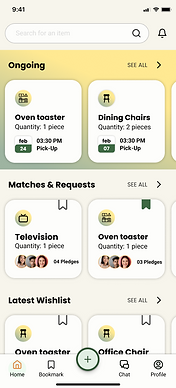


Verified VWOs can securely log in, view pledges, check statuses and submit item requests.


In-app chat enables seamless communication between donors and VWOs to coordinate details efficiently.

Real-time push notifications keep donors informed of matches and streamline pickup coordination.


Real-time push notifications provide donors with transparent delivery status updates, reinforcing trust and closure.


An impact dashboard gives donors clear visibility into past donations and their real-world outcomes.


Business & Feasibility Considerations
Potential Revenue Streams:
-
Corporate donation programmes
-
Resale pathways for unsuitable items, with proceeds supporting charities
Key Operational Requirements:
-
Logistics partnerships or scheduled batch pickups for scalability
-
VWO verification process and ongoing relationship management
-
Quality assurance system to maintain acceptance rates
Reflections - What I’d Do Differently
With more time:
-
Involve VWOs earlier as co-design partners
-
Narrow initial item categories
-
Pilot logistics flows with real users
-
Measure success using behavioural metrics rather than aspirational impact
Outcome
The project demonstrates how UX can remove behavioural and logistical barriers. By focusing on clarity, coordination, and trust, Givio reframes decluttering as a confident, repeatable act of giving.
Outcome metric (pilot targets)
-
Donation flow completion rate > 60%
-
Item acceptance rate > 80%
-
Repeat donation rate within 90 days > 20%